This is our activity report for 2017, thank you all for your great contributions!
We look forward to consolidating and enhancing our project in 2018.



This is our activity report for 2017, thank you all for your great contributions!
We look forward to consolidating and enhancing our project in 2018.
A fundamental part of the RVP Iasi project is to investigate the dynamics and significance of intercultural encounters and their role in our re-learning to be human.
Considering the global scope of the project members, we are planning a special volume to emphasize and provide a perspective on the diversity of opinions and experiences.
The investigation will start from a series of questions on the preparation, development and results of intercultural encounters, which the project members are invited to answer.
The questions and answers will make up a volume intended to provide a dialogic overview of our intercultural experiences, to be published in 2018.
First series of questions:
1. What does it mean to be prepared for an intercultural encounter?
2. How would you define a cultural border? What intercultural barriers have you encountered?
3. Which are the space and time coordinates of intercultural encounters? How does the place (one’s own, neutral or virtual) and the time (moment, length) influence the development of such encounters?
4. What can an intercultural encounter produce? What are its effects, from your experience?
5. How do intercultural encounters change the understanding of one’s own culture? Did they affect your view of what it means to be human?
6. What do you expect from intercultural encounters? What did you learn?
The map below illustrates the global network of RVP Iasi Center, built in the development of the project Re-Learning to Be Human for Global Times: The Role of Intercultural Encounters.
The intercultural encounters engendered by the project this year, both in the online environment and in several offline meetings and events, are part of a rewarding process of mutual discovery. By bringing diverse people together in free dialogue, the project is reshaping the world(s) we live in through reflection and action.
May we learn further!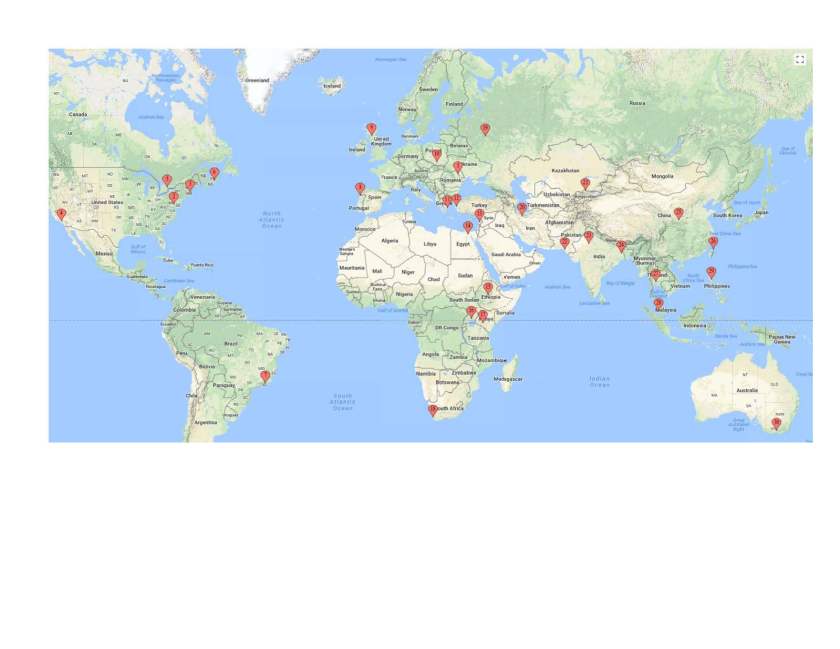
Today’s Saint Andrew celebration brings forth a meditation on the unifying message of religion and spirituality. The founder and first bishop of the church of Byzantium, Andrew is the patron of several cities and countries, including Romania.
In Romania, the Christian holiday of St. Andrew overlaps a traditional celebration associated with wolves and winter, when it is believed that animals can speak and the sky opens at midnight.
This is one example of syncretism leading to a popular contemporary holiday that blends in ancient beliefs and practices. More such examples and comments are invited.


The International Conference of the Council for Research in Values and Philosophy is brought to Iasi by RVP Iasi Center on October 27-28.
Under the topic Re-Learning to be Human for Global Times, this CRVP conference will discuss How Intercultural Encounters (Re)Shape the Contemporary World.
Join CRVP’s International Conference organised in Iasi, Romania by the RVP Center at Alexandru Ioan Cuza University on October 27-28, 2017 under the title:
Re-Learning to Be Human for Global Times:
How Intercultural Encounters (Re)Shape the Contemporary World
As intercultural encounters both home and abroad have become a common event, they bring together individuals and communities, leading to a confrontation of cultural differences and humane similarities. Beyond their challenges, such interactions may generate a new awareness of the other and of the self and an enhanced understanding of what it means to be human.
This conference proposes to investigate the different forms and effects of intercultural encounters, both real and virtual, and to discuss how they shape the contemporary world and their possible impact on re-learning to be human. It aims to find out whether intercultural encounters could produce new forms of communication and revise cultural definitions.
Abstracts can still be submitted by mid-October. More details about the conference are available here on CRVP’s website.
Be it for a sacred space or a seat of power, a common area or a private room, the ceiling represents the upper limit of livable space, as perceived from within. It transforms natural space into a domestic environment. Ceilings are paradoxical elements: their protective obstruction can be creatively turned into a physical or symbolic opening to the above, thus making present what they conceal.
In older and newer cultures alike, ceilings function not so much as a boundary of vision, but as a reflection of a reality which is otherwise not visible and which permeates or makes itself present through this particular physical border. The architecture of roofs and the treatment of the ceilings ultimately reflect a culture’s understanding and symbolic representation of what is above, a beyond opening from top to bottom.
Have you ever noticed a remarkable ceiling? How does it reflect the material heritage and spiritual intuitions of a culture?
Participants in the round table discussions in Iasi and Bucharest and in the international workshop are warmly invited to submit their contributions as soon as possible, with a view to online and/or print publication, at interculturalencounters@gmail.com. Other project members may contribute as well, on the respective topics.
What is a journey without a tale? Whether we take a package tour or venture off the beaten track, to a nearby location or in a distant foreign country, we return with a story to tell. Travellers are storytellers by default, making up their own tale on the way.
What could be the story behind the photos below?


One possible story: A country that rewrites itself every 5 years. Can you imagine returning every few years to a city that is periodically erased and rebuilt from the ground up? What remains of it?
 RVP Iasi Center